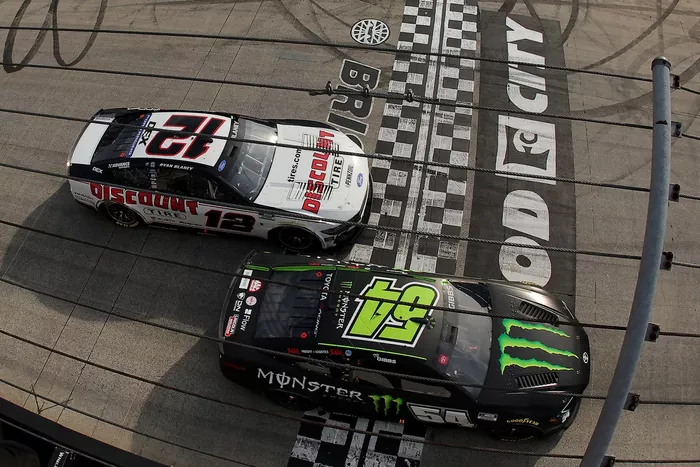
Nascar Cup Series: Strategic Triumphs and Challenges at Bristol Motor Speedway
A Glimpse into High-Stakes Decision-Making
Sunday’s race at Bristol Motor Speedway was not just another round in the NASCAR Cup Series; it was a thrilling showcase of strategy, quick thinking, and the relentless pursuit of victory. At the center of the action was Jonathan Hassler, crew chief for Ryan Blaney’s No. 12 car from Team Penske. As the green flag waved and excitement gripped the crowd, Hassler found himself confronted with a quintessential racing dilemma reminiscent of the infamous Kobayashi Maru test from Star Trek—a scenario with no clear path to victory.
The Kobayashi Maru Challenge Explained
For those unfamiliar, the Kobayashi Maru test serves as a no-win scenario that examines a participant’s decision-making in a high-pressure environment. In this case, it was not just a theoretical test but a real-life challenge facing Hassler. As the race unfolded, Blaney and his team had to navigate the complexities of tire management, strategy, and the unpredictable dynamics of their competitors on the track.
When the penultimate caution flag was waved with just 24 laps remaining, 13 cars were still on the lead lap, and teams had to make a critical decision: to pit or not to pit. The choice was intricately tied to the strategies of those in front and the pressures of the race.
The Strategic Crux: To Pit or Not to Pit
Blaney and Hassler, who had dominated the latter half of the Food City 500, faced a pivotal moment. In racing, the leader’s decisions often dictate the actions of the teams behind them. A bold move to stay out could force others to follow suit, while a decision to pit could provide fresh tires, allowing for enhanced performance. Ultimately, the duo opted to make a pit stop, taking four tires—a gamble that would change the race’s course.
In a calculated risk, Kyle Larson’s crew chief, Cliff Daniels, decided to take only two tires, a decision that would ultimately prove advantageous as Larson surged ahead, outpacing Blaney and jumping into contention.
The Race Unfolds: Drama on the Track
As the race resumed, Blaney’s fight was not over. He quickly maneuvered past Larson, hoping to reclaim his momentum. However, the tactic of relying solely on the lower line of the track proved detrimental in a circuit where speed on the upper line was crucial. Blaney’s admission of perhaps missing his entry by a foot gives a glimpse into the razor-thin margins that separate victory from defeat in professional racing.
“I don’t know if I could have done anything differently,” Blaney mentioned post-race. It’s a sentiment that resonates with many athletes who face split-second decisions that can determine the outcome of their performances.
Crew Chief Perspectives: Evaluating Decisions
Despite the challenges, Hassler reflected positively on their strategy. “We had talked about this exact scenario,” he explained, emphasizing the importance of foresight and preparation in motorsport. Every race is a psychological chess match, where teams must anticipate the moves of their opponents while remaining focused on their strategies.
He noted the significance of making choices based on the given circumstances. “They’re just going to do the opposite of whatever you do,” he stated, shedding light on the strategic dance that dominates the pit road area as race leaders try to leverage their positions without sacrificing performance.
A Competitive Landscape: Insights from Crew Chiefs
The collaborative yet competitive nature of the NASCAR Cup Series was evident as crew chiefs weighed their options. Tyler Allen, another crew chief in the mix, shared that extensive discussions had already taken place regarding potential strategies. Every caution presented a fresh slate for decision-making.
“I’d much rather have control of the race than be trying to go catch somebody,” said Allen, revealing the internal battle of strategic risk versus cautious pragmatism that each crew chief faces.
In a sport where success often hinges on these pivotal moments, the ability to adapt and adjust strategy in real-time is fundamental. The race saw formidable competitors like Tyler Reddick and Ty Gibbs reminding everyone of the fine line that separates the victors from those who fall short.
Post-Race Reflections and Looking Forward
As the dust settled and the champions were crowned, it’s clear that Hassler and his team, despite not achieving victory, have established themselves as a formidable force in the Rally for the NASCAR Cup Championship. “I think our team has been super good,” Hassler noted, emphasizing their performance and speed throughout the season.
Despite setbacks, including issues with their pit crew, which they openly acknowledge need improvement, the focus remains on building momentum and refining their strategies for future races.
The Bristol race showcased not only the incredible skills of the drivers behind the wheels but also the brilliant strategies devised by their crews. In the unpredictable realm of NASCAR, each race becomes an intricate battlefield—a testament to the continual pursuit of perfection in the sport.
Conclusion: The Race Is Never Over
As a new week begins in the NASCAR circuit, teams and fans alike eagerly anticipate what lies ahead. The complexities of decision-making, the thrill of competition, and the spirit of teamwork will remain central to the narrative of the NASCAR Cup Series. The march toward the championship continues, and with each passing race, the excitement builds as every lap unfolds like a story within a larger epic.
Onward to the next challenge, where only the best-prepared will rise to the top, demonstrating once again that in the world of NASCAR, the race never truly ends.