Analyzing the Impact of the Safety Car on the Recent Japanese Grand Prix
The recent Japanese Grand Prix showcased the incredible unpredictability of Formula 1 racing, highlighted dramatically by a pivotal moment: the deployment of the safety car triggered by Haas driver Oliver Bearman’s unfortunate crash on lap 22. This incident didn’t just serve as a safety measure but also shifted the dynamics of the race, notably affecting Oscar Piastri’s bid for victory. At that point in the race, Piastri was in a promising position, having already completed his mandatory pit stop and finding himself in the projected lead.
However, the safety car’s timing inadvertently benefited Mercedes driver Kimi Antonelli, allowing him to make a strategic pit stop that ultimately enabled him to surpass Piastri once the race resumed. This begs the question: would Piastri have been able to maintain his lead had the safety car not been deployed? Furthermore, would Mercedes’ speed have ultimately prevailed, and could it have been Antonelli or his teammate George Russell who clinched the win?
The Pace of Russell: A Barrier to Victory
Addressing the performance of George Russell provides insight into the competitive landscape that day. Data suggests that regardless of the safety car’s deployment, Russell would have faced significant difficulty in clinching the race victory. His inability to keep pace with his competitors raised doubts about his potential for victory.
After a disappointing start that saw him drop to fourth, Russell exerted effort to reclaim second place. However, despite finding himself in clearer air following his pit stop, he struggled to match Piastri’s speed. After Piastri’s pit stop on lap 18 designed to counter an undercut from Russell, the latter finally had the freedom to push—yet it became evident that his pace was inadequate. Analyzing their respective lap times in clear air illustrated that Antonelli was consistently faster—by an average of 0.61 seconds per lap compared to Russell.
Strategic Decisions Under Pressure
Mercedes made a tactical decision to pit Russell on lap 21, acting defensively against Charles Leclerc, who was lapping faster at the time. Unfortunately for Russell, he never regained the necessary speed during the second stint. Team principal Toto Wolff noted that Russell’s struggles stemmed from a poor setup that had impacted him during qualifying and ultimately throughout the race.
In reality, the only scenarios that might have paved a path to victory for Russell would have involved either an earlier safety car or a well-timed late pit stop that could position him to capitalize on fresher tires. However, both scenarios remained in the realm of hypothetical planning, emphasizing the need for consistent speed throughout the race.
Antonelli’s Strategy: A Different Story
While Russell’s competitiveness may have flagged, Kimi Antonelli remained a significant variable. His performance in Japan clearly marked him as the faster Mercedes driver despite initial challenges due to a poor start and traffic battles with fellow racers Norris and Leclerc. Once he found himself in clean air, however, his speed surged.
Had the safety car not interfered, Mercedes would likely have opted for an overcut strategy during Piastri’s pit phase. Pre-safety car data indicated that Antonelli was positioned roughly 18 seconds behind Piastri. A pit stop at Suzuka typically takes around 21.5 seconds, which meant Antonelli would have reemerged right on Piastri’s tail—an aggressive strategy that could have potentially involved switching to softer tires for the final stint.
The Second Stint: Mercedes Rising Above the Competition
During the second stint, the superiority of the Mercedes team became abundantly clear. Antonelli’s ability to maintain an average lap time approximately half a second faster than his competitors underscored this. When factoring in the theoretical benefits from a potential overcut, the overall advantage could balloon to over nine-tenths of a second per lap throughout a significant period of the race.
Considering the minor degradation of the hard compound tire averaged just 0.037 seconds per lap, Antonelli’s speed advantage paints a picture of what could have been had the race unfolded differently. His performance against a well-positioned Piastri showed that even with fresh, hard tires, he may have found a way to overhaul Piastri even without the safety car’s intervention.
Competition: A Closer Race on the Horizon
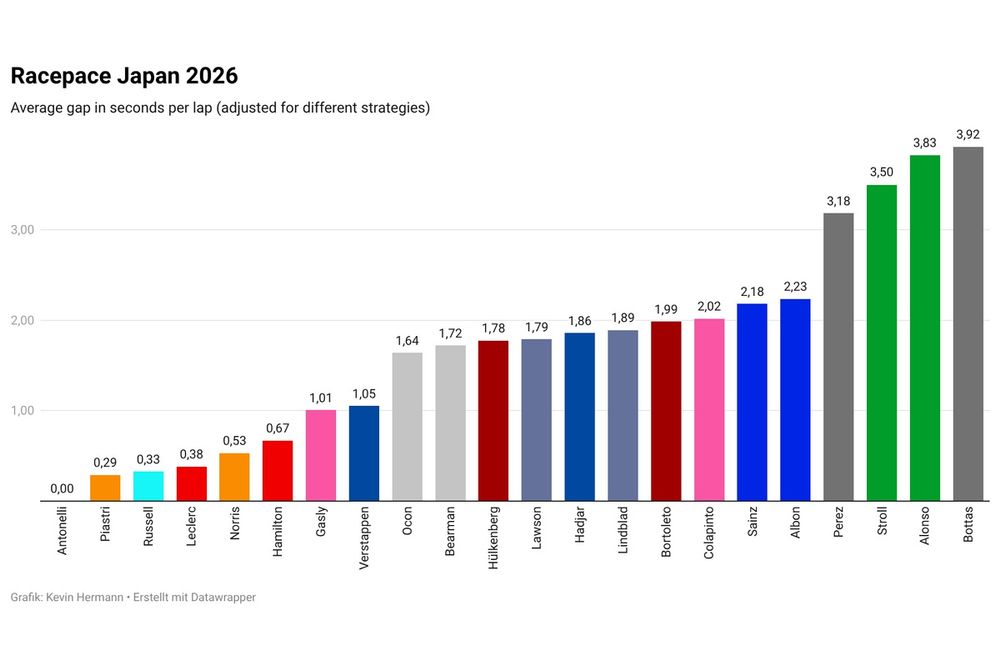
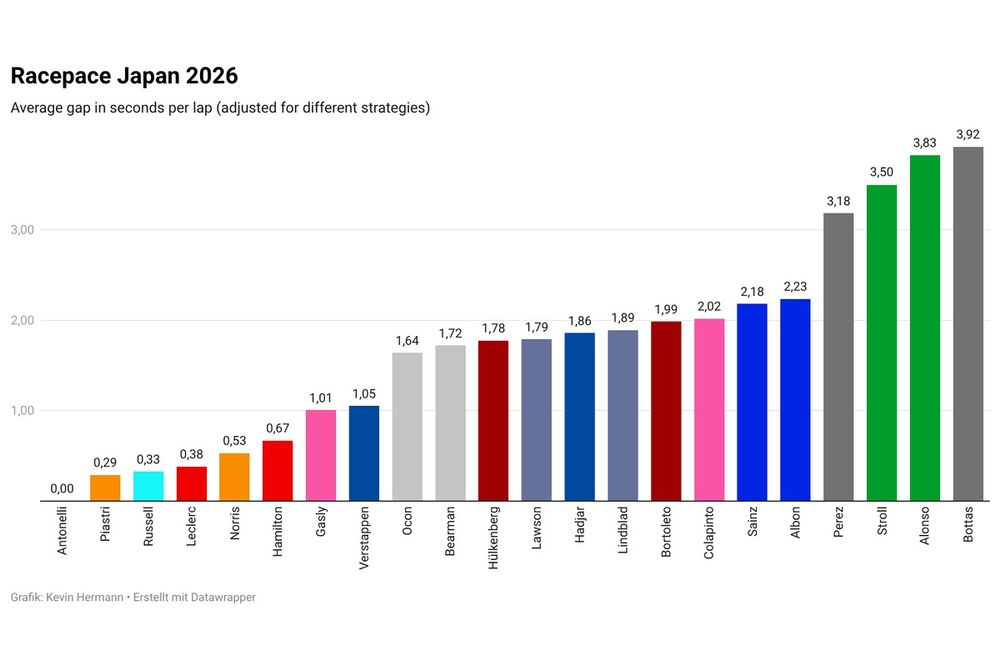
The unfolding of the race led to a captivating yet ultimately revealing landscape regarding competition among the top teams. Although the gap between Mercedes and its rivals—McLaren and Ferrari—was narrower than in earlier races, it became evident that Mercedes remains the benchmark within the field. Both McLaren and Ferrari demonstrated closer lap times, with average gaps of 0.29 seconds for McLaren and 0.38 seconds for Ferrari over the duration of the race.
In clean air, during the more representative second stint, McLaren and Ferrari showcased their development strides, recording lap times that were more competitive than in previous outings. McLaren’s average gap of +0.53 seconds to Mercedes and Ferrari’s +0.55 seconds showed a marked performance boost compared to earlier races in the season where the gaps were significantly larger.
Conclusion: Unraveling the Threads of Strategy
The aftermath of the Japanese Grand Prix prompts profound discussions about strategy, pace, and competition dynamics in Formula 1. Did the safety car cost Piastri the victory? It remains highly debatable, as various factors converged to define the race outcome. Ultimately, while Mercedes proved dominant, both McLaren and Ferrari highlighted a promising closeness, hinting at an exhilarating battle ahead in the season. As for Antonelli, his undeniable speed showcased a formidable challenge for the title as the season progresses, propelling the question: just how much closer can the competition draw in this thrilling pursuit of motorsport excellence?